

If someone told you they'd get your website ranking on page one in 30 days, they're either lying or selling something dodgy. The real answer? SEO takes 3 to 12 months to show results. Sometimes longer.
We sat down with Alannah, our SEO Team Leader, to talk about the question every small business owner asks: when will I actually see results?
Watch the full video here:
How Long Does SEO Actually Take?
Most small businesses see meaningful results between 6 and 12 months. Some competitive industries take even longer.
But here's what matters more than the timeline: understanding why it takes this long and what's actually happening behind the scenes.
"There are new pages being released on Google every day," Alannah explained. "And Google is a bot. It's an engine that has to crawl all of these pages."
She explained, "We don't control Google's crawling of pages. There are things that we can do to make this crawl happen faster, but at the end of the day, we have to let it know that we've made these changes, and then it will put it in the queue and get to it."
So right away, you're dealing with a factor completely outside your control. Google has to find your changes, process them, compare them to competitors, and decide where you rank. That takes time.
The Three Main Reasons SEO Takes Time
Google has to crawl and index your site. Every change you make goes into a queue with millions of other website changes. Google processes these at its own pace, not yours.
Competition matters. If you're a local plumber in a small town, you'll rank faster than a law firm in Sydney, competing against established players with years of authority.
Trust builds slowly. Google doesn't immediately trust new websites or content. You need to prove yourself through consistent quality, legitimate backlinks, and user engagement over time.
Why Does SEO Take So Long?
Think of SEO like compound interest. You invest money, wait, and the returns feel tiny at first. But give it time, and those returns build on themselves.
Alannah put it well: "It's like compound interest, it grows and grows. And it's not until you've let something run and tick over and Google crawl it and re-crawl it and experience it and compare it to your competitors, that you can really test the performance of it."

Crawling Has Slowed Down
Here's something important. Alannah mentioned that over the last 12 months, Google's crawling has gotten slower. "We've seen case studies where we'll test something and won't see the result from it for up to six weeks, maybe longer."
Why? There's just more content now. Every business is publishing blog posts, updating pages, and creating new content. Google's crawlers have to work through all of it.
The Rank Transition Period
When you make changes to your site, you might notice your rankings fluctuate wildly for about 90 days. Sometimes they even drop before improving.
This is called the Rank Transition Algorithm. Google is testing where your page should actually rank. It's not broken. It's the algorithm working to prevent manipulation and find the right long-term position for your content.
This is why patience matters so much. Your rankings during this 90-day period aren't your final rankings.
The Patience Problem
One of the biggest mistakes? Making changes, not seeing results after a few weeks, then panicking and reverting everything.
"We see SEOs freaking out, reverting the changes before they've actually even given it a chance to perform," Alannah said. "I always tell my team that sometimes the difference between an inexperienced SEO and a seasoned one is the ability to wait and show restraint."
You're essentially resetting the clock when you do this. Google never got to properly evaluate your changes.
What Factors Influence Your SEO Timeline?
Industry Competition
This is the biggest factor. A plumber in regional Queensland will rank faster than a mortgage broker in Melbourne.
When we asked Alannah about quick ranking promises, she was blunt: "Something we hear from competitors in our industry is we'll rank you within three months or your money back. But for what? Those guarantees are meaningless unless you're in a tiny niche with zero competition."
Your Website's Starting Point
New websites start from scratch. Google doesn't know you. You have no backlinks, no authority, no trust signals. Everything needs to be built.
Established websites have an advantage. Even if they're not optimised, Google knows they exist. There's some foundation to work with.
Domain Age and History
Older domains typically rank faster than new ones. Not because age itself is a ranking factor, but because older domains usually have more backlinks, more trust signals, and a longer history with Google.
But this doesn't mean you should rush out and buy an aged domain. A relevant domain for your business is better long-term.
Technical Health and Core Web Vitals

If your site is slow, broken, or hard for Google to crawl, nothing else matters. You're driving with the handbrake on.
Google cares about user experience. Core Web Vitals measure how fast your page loads, how quickly users can interact with it, and whether elements shift around while loading.
Site speed, mobile responsiveness, proper URL structure, XML sitemaps. These need to work before SEO can take off.
You can test your site speed using Google's PageSpeed Insights tool. It's free and shows you exactly what needs fixing.
Content Quality and Search Intent
Google looks for content that answers questions and provides value. Keyword stuffing doesn't work anymore. Your content needs to show expertise and authority.
Even great content won't rank if it doesn't match what people are actually looking for. Search intent is the problem someone's trying to solve when they type in a search.
If someone searches "best running shoes," they want reviews and comparisons. If they search "buy Nike Air Max size 10," they want to purchase. Your content needs to match that intent.
Backlinks and Authority
Quality backlinks from other reputable sites speed up your timeline. They're like endorsements. Google sees them as votes of confidence.
But earning these takes time. You need to create content worth linking to, build relationships, and let your reputation grow naturally.
How long do backlinks take to work? Generally, you'll see effects in about 3 months after acquiring them. This depends on how often Google crawls your site and the quality of the backlinks.
Budget and Resources
Money doesn't buy rankings. Google can't be bribed. But your budget impacts how fast you can execute a strategy.
With a bigger budget, hire experienced professionals, subscribe to SEO tools, create more content, and invest in quality link building.
With a smaller budget, you're often learning as you go. Progress takes longer.
That doesn't mean you can't succeed with less money. You just need more patience and a better strategy.
What to Expect at Each Stage
Months 1-3: Foundation
The first three months are about getting the basics right.
"The first one to three months of your campaign is really about your foundation," Alannah explained. "We want to get your name out there, your NAP, which is name, address, phone number, is the same and consistent across everywhere."
What you'll be doing:
- Running a technical SEO audit to find crawl errors, broken links, and indexing issues
- Researching and mapping keywords to specific pages
- Fixing major technical issues
- Optimising your most important pages (title tags, headers, meta descriptions)
- Setting up Google Analytics 4 and Google Search Console
- Claiming your Google Business Profile
What you should see:
"Within the first one, two, three months, we'd want you to start showing up for your branded terms and experiencing some quick wins straight off the bat for some of your main keywords."
You might rank for your business name and maybe a few less competitive keywords. It's not dramatic, but it's progress.
Months 3-6: Momentum Builds
"Within months three to four, we would start to see some momentum across your content," Alannah said. "Your backlinks would start to get some action. Some of your long tail keywords might start to rank."
What you'll be doing:
- Publishing new optimised content
- Starting link outreach
- Submitting updated sitemaps
- Monitoring keyword movement (you'll see fluctuations)
What you should see:
Long-tail keywords start ranking. These are longer, specific search phrases like "emergency plumber Brisbane North" instead of just "plumber." They rank first because they're easier and often convert better.
"We're getting fewer tyre kickers and time wasters," Alannah pointed out. "We'd want your actual dream customer to start seeing your content."
Traffic shows slight increases. Pages start appearing in "People Also Ask" boxes.
Months 6-12: Real Progress
"From your six to 12 month period, your content's really gaining some authority, you're gaining some traffic," Alannah said.
What you should see:
- High-value keywords ranking on page one
- Consistent growth in organic traffic
- Better engagement metrics
- Actual conversions from organic search
- Natural backlinks accumulating
12 Months and Beyond: Compound Growth
"12 months plus is really about that compound interest," Alannah explained. "That's when we start to rank for harder terms, your website's gaining authority, your content is getting good traffic."
SEO becomes self-reinforcing. Your authority helps new content rank faster. Existing content keeps attracting backlinks.
Alannah mentioned clients who've worked with us for years: "We've got clients now where their website is their business. If they didn't have their website, they wouldn't be turning over $50 million in profit a year. And that's because they started seven years ago, 10 years ago, doing their SEO on a small budget."
Understanding Google's E-E-A-T Principles
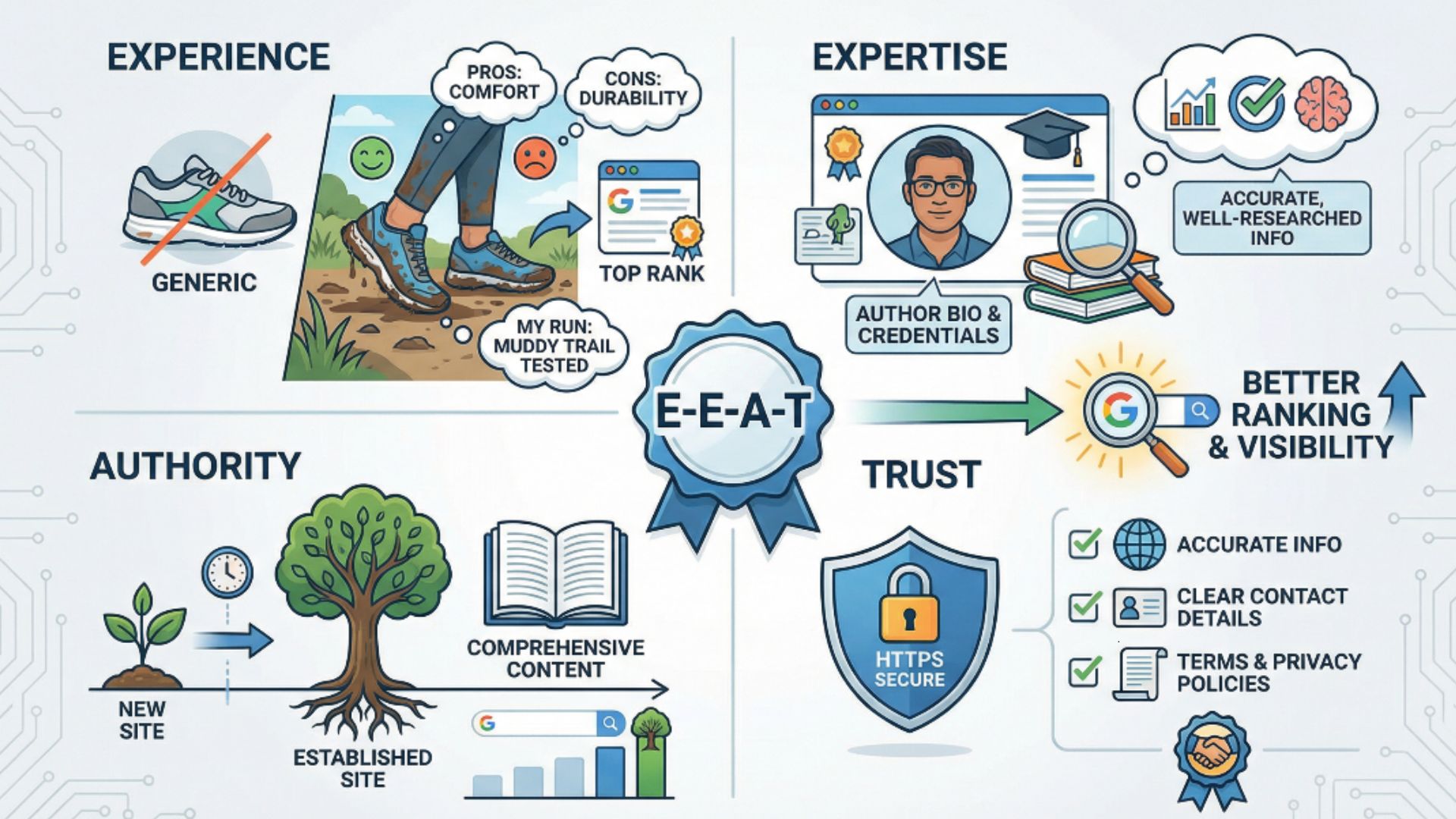
Google uses four key factors to determine content quality: Experience, Expertise, Authority, and Trust.
Experience: Google favours content that demonstrates real-world experience. Don't just write generic descriptions. Share actual experiences. If you're writing about running shoes, talk about real usage. What worked? What didn't?
Expertise: Google wants content from people who know what they're talking about. Include author bios that highlight credentials and experience. Make sure the content is well-researched with accurate information.
Authority: Older, established websites generally rank faster. But you can build authority by producing well-researched, comprehensive content.
Trust: Build trust by maintaining a secure website (HTTPS), providing accurate information, having clear contact details, and displaying terms and privacy policies.
How Often Should You Publish Content?
Quality beats quantity. Every time.
It doesn't matter if you produce 4 blogs a month or 40 blogs a month. What matters is that each piece has depth, satisfies user intent, and provides genuinely engaging content.
Produce better content than your competition to rank higher and faster. But "more" doesn't mean volume at the expense of quality.
Also consider refreshing existing content. A good strategy includes both new content and updating older posts to keep them relevant.
SEO vs Paid Ads: Should You Choose?
No. You shouldn't choose. You should do both if possible.
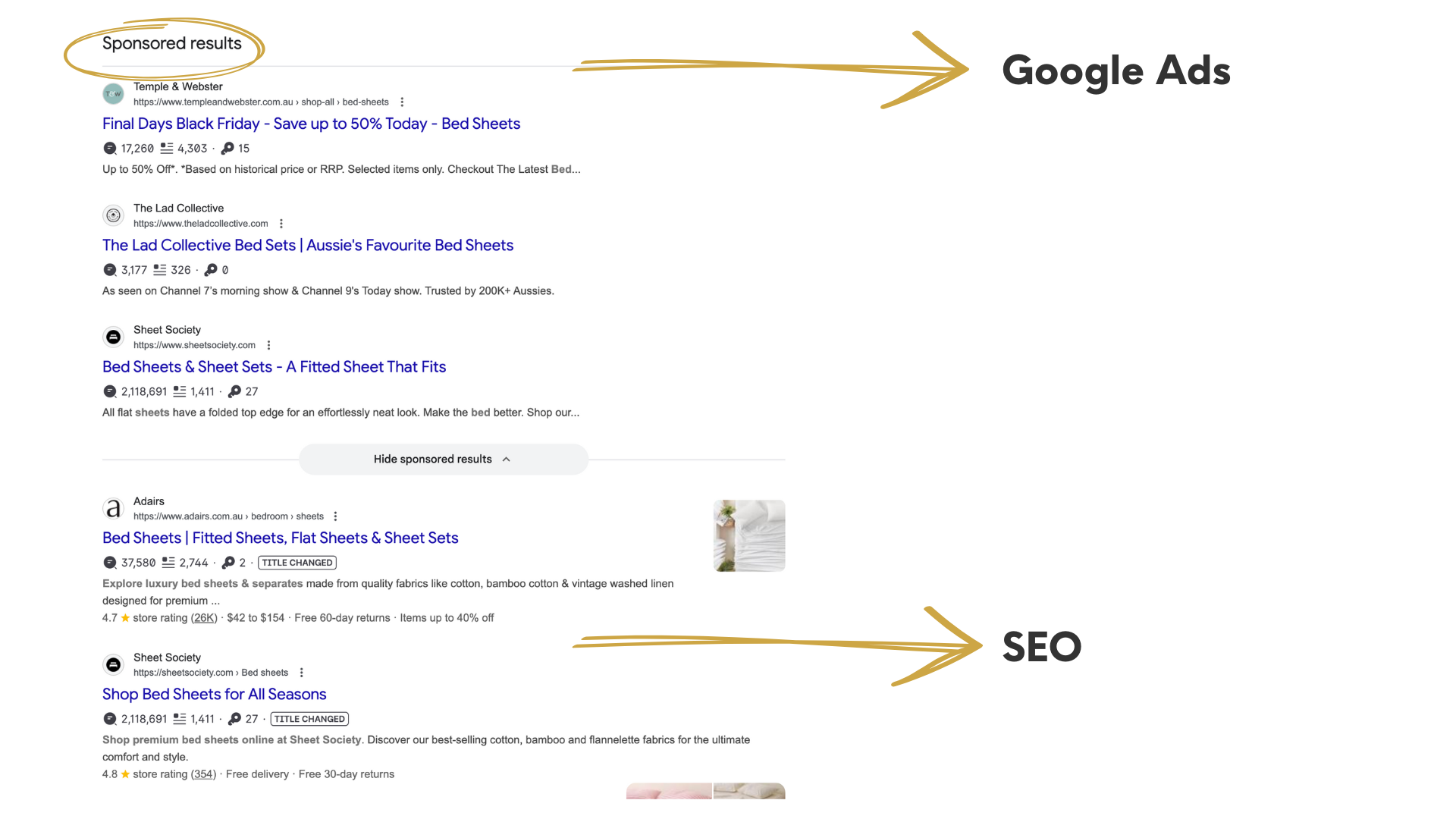
"If you really need quick results, there are other marketing channels out there," Alannah said. "Ads is a great example. Ads are great for getting you out of the gate, but SEO is that long-term profitability."
But she was clear: "I never want my clients to have all their eggs in one basket. SEO is a brilliant long-term organic strategy that's going to save you a lot of money. But to get leads right in the door right when you need them, PPC is the way to go."
A Cautionary Tale
In 2019, one of our team members ran an e-commerce store. Google Shopping Ads were crushing it. Six figures came quickly. Everything seemed sorted.
A mate running a similar store kept saying to do SEO alongside the ads. But the response was, "Why bother? Things are going great."
Twelve months later: ad costs had gone up. Competition intensified. Bigger players entered the market. Sales fell off a cliff. The store closed.
Meanwhile, the mate's business? Thriving. Same competitive market. But he'd been building SEO the whole time. When paid ads became unsustainable, most sales came from organic traffic.
That's the lesson. SEO is your insurance policy against changes in paid advertising.

Common Mistakes That Kill Your Timeline
Reverting Changes Too Quickly
Make changes, panic after a few weeks, revert everything—you've just started over.
Remember the Rank Transition period—rankings often fluctuate for up to 90 days before settling. This doesn't mean something's broken. It's the algorithm doing its job.
Wrong Expectations About "Results"
Measure results incrementally. Ranking for your brand name? That's a result. Ranking for long-tail keywords? Progress. Traffic increasing 10-20% month-over-month? That's compound growth starting.
Ignoring Technical Issues
Don't pump money into content creation while your website takes 10 seconds to load or isn't mobile-friendly. Fix the foundation first.
Believing "Guaranteed Rankings" Promises
If someone promises to rank you on page one in 30 days or your money back, they're either lying or working in a niche with zero competition.
SEO doesn't work that way. Rankings can't be guaranteed because Google's algorithm changes constantly.
How to Speed Things Up (Without Cutting Corners)
Fix Technical SEO First
Don't spend months creating content if your site can't be properly crawled or loads slowly. Get the foundation right. Everything else builds faster.
Target Low-Competition Keywords First
Instead of going after the most competitive terms immediately, target long-tail keywords where you have a realistic chance of ranking sooner. Build authority there, then expand.
Produce Quality Content Consistently
One good piece per week beats seven mediocre pieces. And it's better than publishing sporadically with no strategy.
Build Relationships for Links
Quality backlinks speed up SEO results, but they take time to acquire. Build genuine relationships in your industry. Create content people want to link to.
Get the Right Help
Whether working with an agency or doing it yourself, experience matters.
As Alannah said: "If you're on a time crunch and you need to see results within three to six months, having somebody with experience is really gonna be the difference."
Essential Tools to Track Progress
It's hard to improve what you don't measure.
Google Search Console (Free): Shows how Google sees your site. Track impressions, clicks, and crawl errors. Essential.
Google Analytics 4 (Free): Tracks user behaviour, conversions, and traffic trends.
Google PageSpeed Insights (Free): Tests your site speed and shows what needs fixing.
Paid Tools Worth Considering:
Semrush: Good for keyword tracking and competitor analysis.
Ahrefs: Excellent for backlink analysis and keyword research.
Screaming Frog: Great for technical SEO audits on small to mid-sized sites.
Start with free tools if you're testing the waters. Invest in paid tools as you scale.
The Reality: Think in Years, Not Months
This article probably doesn't have the magic answer you wanted. SEO is a long game. Anyone who says otherwise is either lying or doesn't understand how it works. (if you don't, here's a great resource to learn how SEO works)
But here's what matters: the best time to start SEO was a year ago. The second-best time is today.

Alannah shared something that sums it up: "I think the only regret people have with SEO is not starting it sooner."
Five years isn't long in business. It goes fast, especially when you're juggling everything as a small business owner. So the real question isn't "How long does SEO take?"
The real question is: "Do you want to start building compound interest now, or still be thinking about it a year from now?"
If you're a small business owner looking for sustainable growth, SEO isn't just marketing. It's an investment in long-term viability. It ensures you're not completely dependent on paid advertising or word-of-mouth.
Will it require patience? Yes. Will there be a period where you invest without seeing huge returns? Probably. But if you commit, stay consistent, and work with people who know what they're doing, the results compound in ways that transform your business.
And that's worth waiting 6 to 12 months for.